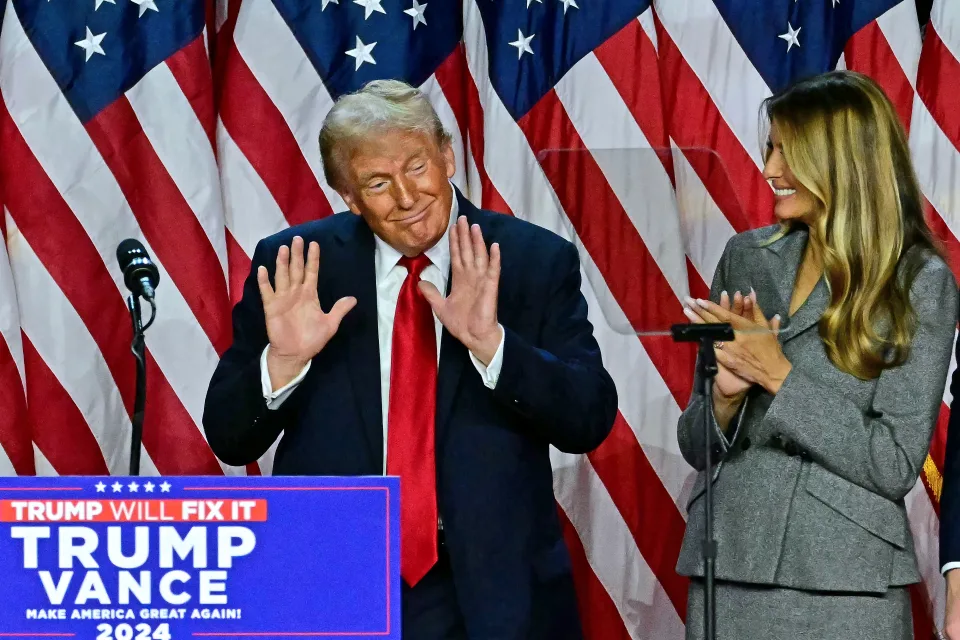
Washington, April 3, 2025 – President Donald Trump on Wednesday declared sweeping tariffs of 10% on imports from all countries amid warnings from around the world that retaliation would follow, fueling tensions in a global trade war.
The much-anticipated announcement fulfilled the president’s vow to hit back against countries he says have treated the U.S. unfairly.
Trump has long threatened reciprocal tariffs against countries around the world, but the president on Wednesday announced a different plan: The U.S. will charge dozens of nations half of their current tariff rate and other fees on American imports.
Among the most prominent countries hit by the reciprocal tariffs are China at 34%, Japan at 24%, the European Union at 20%, India at 26%, Vietnam at 46% and Taiwan at 32%.
“Reciprocal,” Trump said. “That means they do it to us and we do it to them.’’
Trump’s universal tariffs on will go into effect Saturday at 12:01 a.m. and his reciprocal tariffs will hit on April 9 on new imports of foreign-made goods.
Trump says tariffs will force other countries to lower their own rates on U.S. goods and services, creating a more balanced economic playing field for U.S. exports and a strong incentive for companies to manufacture goods such as cars inside the U.S. to avoid paying the tax. However, some analysts warn that the costs of tariffs will be passed along to American consumers.
Even before the announcement, nations pledged to fight back. Canada said it was preparing countermeasures and China, Japan and South Korea were working on a unified retaliation. The EU said it would “calibrate our response.”
The announcement came the same day Trump was rebuked by the Senate, where four Republicans crossed party lines to pass a resolution 51-48 to end the emergency declaration enabling tariffs against Canada.
The resolution has virtually no chance to be approved in the GOP-controlled House and, even if it did, would have to be signed by Trump to become policy.
The tariffs are the latest in a series of levies Trump has announced since taking office in January. They include 25% tariffs on imported steel and aluminum, on imported automobile and automobile parts and on goods from Mexico and Canada.
All those levies have fueled vehement objections from the targeted countries and industries.
Four Republicans cross Trump in vote to stop Canada tariffs
The resolution to end the emergency declaration enabling Trump’s tariffs against Canada, put forward by Sen. Tim Kaine, D-Va., was intended to get Republicans on the record regarding the policy.
Sen. Rand Paul, R-Ky., co-sponsored the measure and was joined voting in favor Wednesday by fellow Republicans Mitch McConnell of Kentucky, Susan Collins of Maine and Lisa Murkowski of Alaska, drawing Trump’s ire even before the vote.
Fortune
Though highly unlikely to pass the House, the resolution is the first official marker of a handful of Republicans’ stance on the controversial tariffs, which have raised widespread concerns about significantly hiking the cost of goods.
Trump contends he imposed the tariffs on Canada to pressure its government into curtailing fentanyl traffic across the northern U.S. border.
Canadian officials, mystified by Trump’s targeting, have said fentanyl seizures by U.S. agents at the northern border made up less than 0.1% of total U.S. seizures of the drug from 2022 to 2024.
Low-income households would feel tariff pain the most
Some economists predict Americans will feel the pain from Trump’s tariffs, at least in the short term, and low- income Americans most of all.
If the administration rolls out tariffs as high as 20% on a broad range of goods and trading partners retaliate, the lowest-earning households with an average disposable income of about $43,000 would see that figure drop by as much as 5.5% − $2,365 − compared to 1.9% for the highest-earning households with disposable income above $500,000, according to a new analysis from Yale Budget Lab.
“A tariff is what we call a regressive tax because it pinches families at the bottom more than it does families at the top,” Ernie Tedeschi, director of economics at the Yale Budget Lab, told USA TODAY.
Lower-income households are more exposed to tariffs relative to their earnings because they spend a greater share of them, Tedeschi said. In dollar terms, higher-income households get hit harder: An average of $9,500 per household per year for those in the top tenth and $3,800 for those in the middle.
The impact of tariffs would escalate over time for wealthier households as prices on assets such as stocks, bonds and real estate decline, the Yale Budget Lab analysis showed.
Trump touts tariffs, others skeptical
Last week, Trump imposed a 25% tariff on imported passenger vehicles, light trucks and some auto parts. For imported cars protected by the United States-Mexico-Canada Agreement, only the foreign parts that make up the vehicle will be subject to the tariff.
Before that, the Trump administration slapped 25% tariffs on goods from Mexico and Canada, as well as 10% tariffs on imports from China.
“We’re going to charge countries for doing business in our country and taking our jobs, taking our wealth,” Trump said. He said the tariffs will “spur growth like you haven’t seen before.”
Moody’s Analytics Chief Economist Mark Zandi was less bullish on tariffs, telling CNN “there’s no good case here … It’s just dark variations on a dark theme.”
Financial markets sink in after-hours trading
After rising early Wednesday, U.S. stocks took a dive in after-hours trading following Trump’s announcement.
The broad S&P was down 1.8%, the Dow Jones Industrial Average was 0.6% lower and the tech-heavy Nasdaq slid more than 2.4%. For the day’s session, the S&P 500 added 37.90 points, 0.7%, to close at 5,670.97. The Dow gained 235.36 points to hit 42,225.32, up about 0.6%, and the Nasdaq tacked on 151.16 points or 0.9% to close at 17,601.05.
Investors had hoped the tariffs would be targeted, narrow and levied on a handful of countries. Over the weekend, however, Trump said his reciprocal tariffs would “start with all countries.” Reports also said he was pushing his advisers to be more aggressive.
The markets have experienced wild swings in recent weeks, but all three major stock indexes closed the first three months of the year lower. The S&P 500 and Nasdaq had their worst first-quarter performance since 2022. “I’ve never seen anything like this. There’s so much uncertainty. We just don’t have answers,” said Christine Short, vice president of research at analytics company Wall Street Horizon