
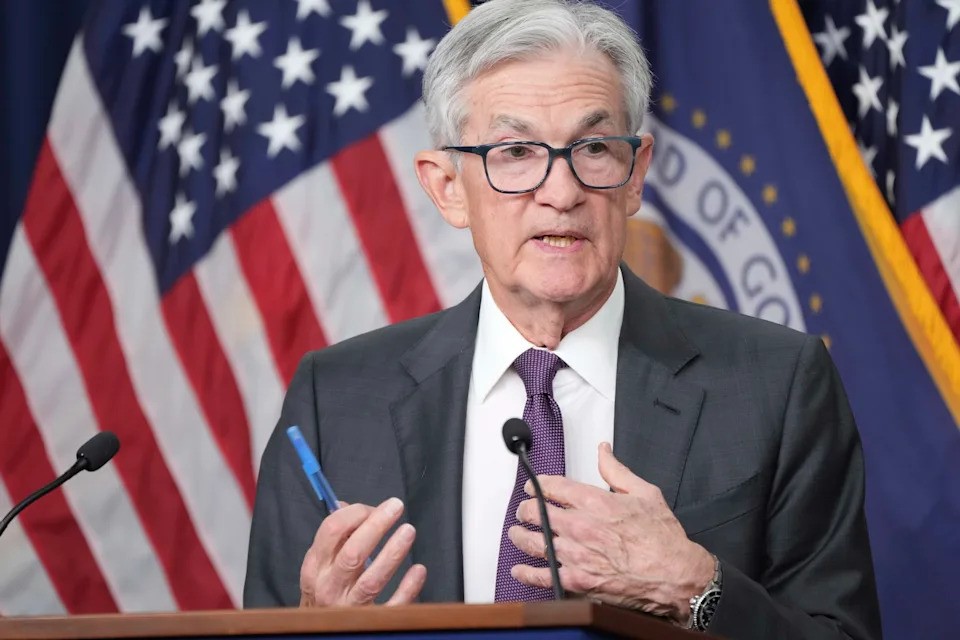
Washington, April 5, 2025 – Federal Reserve Chair Jerome Powell on Friday appeared to back away from a “base case” view that inflation from President Trump’s new tariffs could be transitory, saying that “it is also possible that the effects could be more persistent” as the economy digests “significantly larger-than-expected” gtrade duties.
Trump, at the same time, turned up the pressure on Powell, calling on him to lower rates.
“This would be a PERFECT time for Fed Chairman Jerome Powell to cut Interest Rates. He is always ‘late,’ but he could now change his image, and quickly,” Trump posted on social media, adding, “CUT INTEREST RATES, JEROME, AND STOP PLAYING POLITICS!”
Powell made it clear during his remarks at an event in Arlington, Va., that the Fed isn’t in a hurry to take any action on rates due to many uncertainties, saying, “It is too soon to say what will be the appropriate path for monetary policy.”
But because it is now clear Trump’s planned tariffs are exceeding expectations, he added, “The same is likely to be true of the economic effects, which will include higher inflation and slower growth.”
While the size and duration of those effects “remain uncertain,” the inflation impact has the potential to be longer lasting, he noted.
“While tariffs are highly likely to generate at least a temporary rise in inflation, it is also possible that the effects could be more persistent.”
The acknowledgement that inflation has the potential to be more persistent differs from a stance that Powell took last month in a press conference with reporters, where he said that his “base case” was that any extra inflation from Trump’s slate of tariffs would be “transitory.”
That transitory stance aligned with a view also expressed earlier by Treasury Secretary Scott Bessent.
Trump certainly made Powell’s job that much more difficult this week as he unveiled the steepest tariffs in more than 100 years.
Trump’s tariff rollout this week also took markets by surprise, spurring the worst one-day rout in US stocks since the start of the 2020 COVID-19 crisis in March 2020. Stocks fell again Friday, deepening the market turmoil.
Economists scrambled to revise their forecasts in ways that present twin challenges for the central bank: higher inflation and slower growth. Maybe, as some economists said, a US recession.
Traders reacted by boosting the number of interest rate cuts they expect to see from the central bank this year to four, as they bet recessionary worries will outweigh concerns about rising prices. They expect the first cut in June.
A new labor report released Friday didn’t change those market expectations.
Data from the Bureau of Labor Statistics showed 228,000 new jobs were created in March, more than the 140,000 expected by economists. The unemployment rate rose to 4.2% from the 4.1% seen in the prior month.
Such a solid report certainly is not going to prompt any quick actions from the central bank, according to market observers.
“This type of job report will not favor any kind of hurried cuts,” said EY economist Gregory Daco.
Powell reinforced that wait-and-see stance Friday, saying in his speech that “we are well positioned to wait for greater clarity before considering any adjustments to our policy stance.”
Some of his colleagues this week sounded a similar note. Philip Jefferson, vice chair of the Federal Reserve, said Thursday there is “no need to be in a hurry” to make adjustments to rates.
Fed governor Lisa Cook said Thursday that tariff-related price increases and rising inflation expectations could argue for maintaining a “restrictive stance” on rates for longer to reduce the risk of inflation expectations becoming unanchored.
There is now widespread disagreement among analysts on the Fed’s path.
Morgan Stanley said on Thursday it expects the Fed will not cut rates at all this year due to potential elevated inflation. Evercore said the likelihood of no cuts all the way up to more than five cuts in a recession are all roughly equal, although the firm’s base case is two to three.
Powell on Friday acknowledged that progress toward the Fed’s 2% inflation goal “has slowed,” citing a key gauge that was still at 2.8% in a recent reading.
And “looking ahead, higher tariffs will be working their way through our economy and are likely to raise inflation in coming quarters.”
The central bank’s job, he stressed, is to ensure that a one-time increase in prices “does not become an ongoing inflation problem.”
Trump’s renewed comments about Fed rates Friday follow a period when he had softened his criticisms of the Fed’s monetary policy decisions and even made it clear he doesn’t intend to fire Powell, someone he criticized repeatedly during his first term.
Bessent and other Trump aides have repeatedly said that the president is not focused on the Fed and is instead trying to bring down 10-year Treasury yields.
Powell has said he will not step down as chair before his term is up in May 2026, arguing that his removal is “not permitted by law.”
He repeated that Friday during a question and answer session with journalists: “I fully intend to serve all of my term.”
JPMorgan believes the US economy will enter a recession in the back half of 2025 as the impact of President Trump tariffs takes hold in the economy.
The firm’s chief US economist Michael Feroli sees a two-quarter recession occurring in the back half of 2025 as GDP contracts by 1% in the third quarter of the year and by 0.5% in the fourth quarter. For the full-year 2025, Feroli’s team projects GDP will fall by 0.3%.
“We now expect real GDP [gross domestic product] to contract under the weight of the tariffs,” Feroli wrote in a note to clients on Friday night.
Feroli added that a “recession in economic activity” will push the unemployment rate up to 5.3%. New data from the Bureau of Labor Statistics released on Friday showed the unemployment rate stood at 4.2% in March.
While other economists have noted the risks to recession are rising, JPMorgan marks the first major Wall Street research team to forecast a recession as Trump’s tariffs weigh on economic growth.
“The pinch from higher prices that we expect in coming months may hit harder than in the post-pandemic inflation spike, as nominal income growth has been moderating recently, as opposed to accelerating in the earlier episode,” Feroli wrote.
“Moreover, in an environment of heightened uncertainty consumers may be reluctant to dip too far into savings to finance spending growth.”
Broadly, economists have agreed that Trump’s reciprocal tariffs — which include broad 10% duties and further levies on select trading partners — will spike inflation and hamper economic growth. In Feroli’s base case, core PCE, the Fed’s preferred inflation gauge, would end 2025 at 4.4%. The February reading of core PCE showed prices increased 2.8%.
Feroli’s forecast projects a “stagflationary” environment, where prices increase while growth slows.
Given the Fed’s dual mandate for maximum employment and price stability, this could put the central bank in a quandary. As of Friday, markets had priced in four interest rate cuts from the Fed amid growing concerns about the trajectory of the US economy.
“If realized, our stagflationary forecast would present a dilemma to Fed policymakers,” Feroli wrote. “We believe material weakness in the labor market holds sway in the end, particularly if it results in weaker wage growth thereby giving the Committee more confidence that a price wage spiral isn’t taking hold.”
After Fed Chair Jerome Powell reiterated a patient approach to adjusting monetary policy during a speech on Friday, Feroli noted a “risk” is the Fed doesn’t feel confident enough in the slowing economic data to cut interest rates until after its June meeting.
Feroli’s base case is that the Fed will still cut interest rates by 25 basis points in June and at every meeting after until the central bank brings its benchmark rate down to 3% by January 2026.
Concerns over the impact of Trump’s tariffs have been at the center of a recent stock market rout. Stocks just wrapped their worst last week since a global pandemic brought the world economy to a halt in March 2020.
For the week, the Dow Jones Industrial Average pulled back almost 8%, or about 3,300 points, to enter correction territory. Meanwhile, the S&P 500 sank roughly 9% as the broad-based benchmark approached a 20% drawback from its most recent all-time high. The tech-heavy Nasdaq Composite led the losses, cratering 10% and ending in a bear market as it’s officially down 20% from its most recent all-time high. (Reuters)